Category Archives: Personal

Using Claude in a small C++ library

Long back, I ported LSODA solver to C++ (https://github.com/dilawar/libsoda-cxx) for a neural simulator I was working on during my PhD. This port is almost the same as the reference C code except for STL containers and some other goodies (and some OB1 errors).

Today, I used Claude to improve unit tests and docs and enhance CMake integration.

First, I asked Claude to look in scipy codebase, search for LSODA related tests, and add them to my project. It did a great job and wrote a better commit message than I would have done but that’s not saying much! The tests Claude wrote used assert which is a noop in release build i.e. these assert won’t be there in release build so passing tests in release are meaningless. When I pointed this out, it replaced them with runtime exception that works with both debug and release build. Not cool, Claude but not bad either. Its C++!

Then I ask for a CMake harness so that folks can integrate my library into their CMake based workflow easily. I did OK at first attempt and made a boo-boo which was caught by Coderabbit review bot (free for open source). Claude fixed it later!

All of it took roughly 30 minutes!

If you are very very familiar with existing codebase then I don’t think Claude/AI tools add too much value. With hot cache, I could have done it in one hour. The advantages of 30 minutes of time saving may not be worth losing your touch with something you enjoy i.e. programming and story building in your head. I definitely feel that I am on “opium” when I use it for a long time.

Claude is very very good at things at which I am below average. Which is true for almost all the things I am doing with Claude thee days. So it is not unnatural that these tools enjoy great reputations among users. More objectively, good AI tools are perfect for things that feels like chores e.g. “translate tests from this Python implementation to C++” or “reproduce this bug and when you find it commit it on a branch” or “create a new project with this and that”.

At my last stint at a medium size org that lasted a month, we are asked to use Claude code as much as possible. Sure, I finished a task in half an hour that would have taken a person familiar with the codebase 3 hours but the PR is still pending review after 12 days! So where are the gains? Beware of Amdahl law as well!

As many have pointed out before that AI tools are very eager to achieve success. They will try to achieve it by any means. Once in a while they will stop and ask you but most of time, they will find a plausible solution. Ensure that your prompt has the definition of “success/done” and “properly” articulated. Discuss it with all stakeholders when a ticket is created otherwise you’ll get something that kind of work but it does not.

A guy named Gandhi

What if I tell you that I know a guy who accidentally sliced his butt off like a mango? You can’t make this shit up!

He was a much older kid. His name was Rajeev but we called him Gandhi. He was a simpleton, never used a curse word, always smiling, never seen angry, and often wore white khaadi clothes. Hence the nick name. Having first name Rajeev also helped!

The villain in our story is a fodder/chaff cutter or kutti katne ki machine. Here is a picture. Can you imagine youself slice off your butts with it? I can!

Kutti katne ki machine or chaff cutter. You can use it to slice your butt if you try really hard.

So one fine day in March circa 2004, Gandhi took the blunt blades off the machine, got them sharpened at a nearby town Seohara. And then he put the blades back on. So far so good. To check the alignment, you rotate the wheel with blades and hear the swashing sound blades make when they move across the grass feeder opening. He enjoyed listening to metal sound and rotated the machines as vigorously as he could.

Legend has it that as he was picking tools from the ground, he stepped on a stone, lost his balance and fell back, butt extruded onto the rotating blades. The machine shown in the image is pretty high. Imagine a shorter one and imagine someone falling onto the blades butt first when the blades are rotating. The blades sliced his butts and he fell down unconscious.

Fortunately, his bhabhi saw his falling down. She ran towards him and shouted for help. It is said that the brave woman put the slices back on his buttocks .

He was rushed to a nearby hospital in a tractor and trolley. He was put in a charpai, face down of course. It was a 20 minute journey. He was barely conscious. The trolley was filled with well-wishers and family member, not less than 20 people!

He was driven to the closest hospital in Seohara. Hospitals in town typically have one doctor who sits in his room and patiently forms a line to see him. His relatives barged into the doctor’s room and shouted, “emergency hai doctor sahebm hamare admi ne apni gand kaat li hai!”. (Emergency, doctor. Our man has cut his ass!).

The doctor was too curious to know what happened. Instead of asking to bring patient to him, he walked out of his room to see the patient. Some of his patients were also equally fascinated, one of them still had a thermometer in their mouth. He saw him and chuckled. Strangest case of his life, he claimed and then he suddenly became serious.

“it is a police case. You tried to murder him”, he said, “I’ll report this to the Police first”. Gandhi’s father didn’t like the accusations. He found it almost idiotic. “Array doctor, marna hota to gardan katne, haath per katte, gand katte kya?” (Doctor, if we wanted to murder him, we would cut his throat or limbs, not his ass!). I am told he called the doctor chutiya too!

The doctor was convinced and perhaps a bit embarrassed at this own idiocy. Sure, no one would chop off someone butt a little to murder them and bring them to him for treatment. Gandhi was given sedatives and his butt slices were sewn back. For a few months, he was on a liquid diet else you know! He spend a whole month on a charpai listening to his favorite songs on radio.

Every time someone from my village visited this doctor, he would tell this story to all of his patients.  “In there village, there is a boy who chopped off his butts”, he would say. It wasn’t always appreciated but everyone used to get a good laugh.

Gandhi is married with a few kids. He is doing well. He uses his butts normally, just like you and me. He can ride a tractor and a bicycle too.

Personally, I’ve never seen his injury. I heard multiple version of this story with multiple types of masalas applied to it. He is shy. He doesn’t like to talk about it, let alone showing his injuries to anyone. I don’t know how big the slices were. There are rumors about the number of stitches the doctor needed to put.

A Trip to Pondicherry

    This week, we visited Pondicherry on a three days vacation.

    I started when Somya informed her plan to stay there for few weeks and she invited us to stay with her family. She informed dates in advance. I planned to visit this weekend. Later we got to know that Anjali was there as well during the weekend.

    We decided to drive by car. Ookie is now comfortable inside the car. The inflatable bed that I bought when Anu had plaster on her ankle is serving us really well on these trips. Kaalu sometimes gets pretty stressed and anxious inside car, especially during the day time traffic, so we tried calming tablets and they do wonders for her. I should use them during Diwali when the whole country turns into a loud gas-chamber!

    Driving car to Puducherry from Bengaluru wasn’t the most pleasant experience, especially in the late evening. Almost half of the route was two lane highway. Overtaking slow trucks or auto and avoiding overtaking cars and buses from the other side was also tricky. A lot of vehicles have very bright headlights these days, including small autos, which makes is very hard to see anything when these lights flash in your eyes. The roads were in good shape and except of a speed-breaker that I didn’t see, most of the travel was without any bad bump. We lost 30 mins inside Bengaluru traffic and 45 minutes in a sudden jam on highway. It took us more than 8 hours to reach Pondicherry!

    I think I got some “bio-fuel” (ethanol blended) on the way from a BP/Jio petrol pump. That made car pickup worse and it stinks.

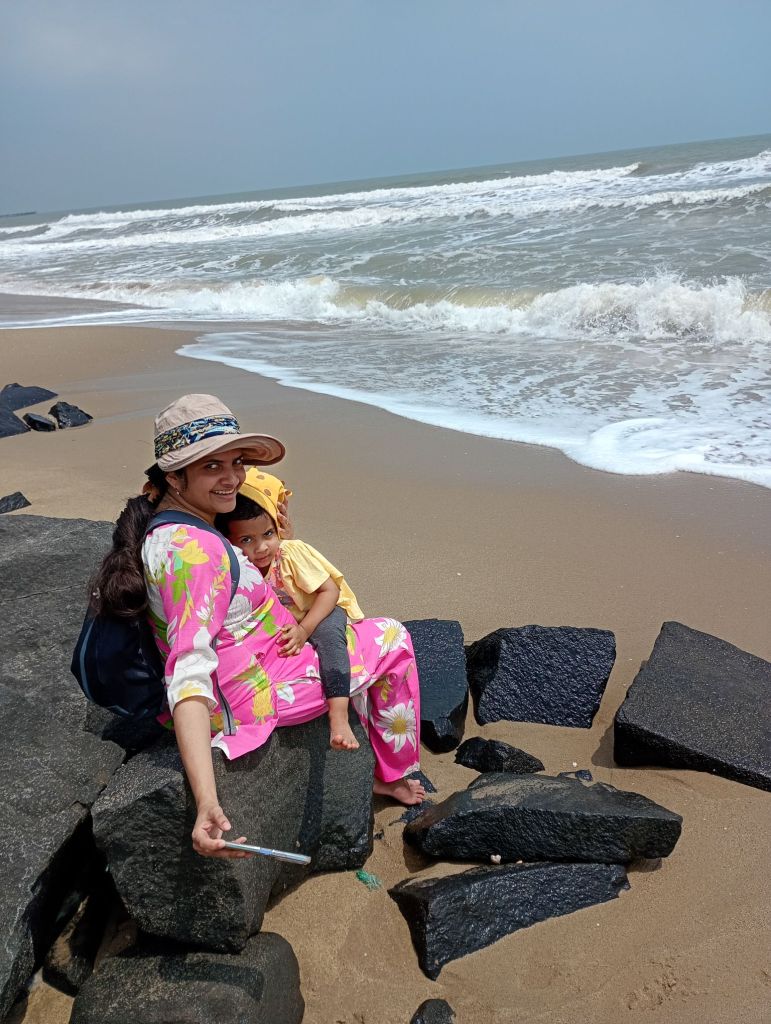
    We reached at Somya place around 9pm and slept after having dinner. Next day, we went to a beach. Neither Ookie nor Kaalu enjoyed the beach. It was their first time and both were scared of big waves. Also, late February turns out to be a little too warm to be on the beach during day time. Unlike west coast (e.g. Mangalore, Mumbai), the beaches in Pondicherry are not shallow and waves are bigger, stronger and dangerous.

    Kaalu and Ookie didn’t like wave crashing near them! Kaalu liked the little crabs on the beach but fear of waves took the fun away. Ookie enjoyed playing in the sand though and Kaalu would dig some sand and lay on it.

    I got to meet old friends and more. Ookie enjoyed the night time at Pomegrade beach. Fortunately, city doesn’t allow vehicle on the beach road and it made all the difference. She walked freely on the beach road. We also bought a funny musical instrument from a road-side vendor. She also enjoyed playing with another toddler in the house who taught her how to jump down the bed!!

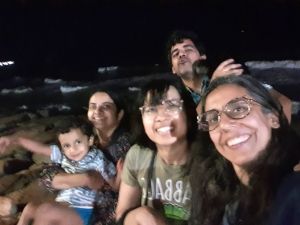
    (clockwise from top) Dilawar, Kaalu, Anjali, Somya, Anu, and Ookie

    I didn’t find Puducherry to be very exciting. But again, I don’t find cities to be very exciting. Food is good but food is usually good in all cities.

    The botanical garden was OK but has nothing worth really visiting. Great for toddlers though. It didn’t have any especial tree or plant to excite me. The flower garden was lame and poorly maintained — I’ve seen better personal garden. The aquarium was also pretty meh but much better than garden. Ookie enjoyed her time inside the aquarium. Sadly, the choo-choo train is broken and is just a show piece now. Perhaps we need the British back to ensure things work?

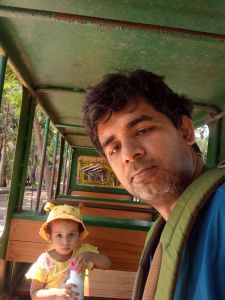
    Ookie and Me in a broken choo-choo train at Pondicherry botanical garden. It’s a shame that this train doesn’t work because they have pretty good track inside the park!

    Beaches are not as dirty as in Chennai but they are not clean either. Occasionally you see broken glass in the sad and put your sandals back on. Our civic senses needs to improve a lot! Also, streets are not walk-able in Puducherry as well, except for one street in Pomegrade beach where they don’t allow cars. I found too many bikes parked on the road most of the time. Bengaluru is definitely worse!

    The local food was very cheap and good and the tea was excellent. I am a great fan of tea making in both Tamilnadu and Kerala. Its a shame that Karnataka and rest of the country hasn’t adopt this method.

    While coming back, we left at 12:00pm. Diving was a pretty decent experience in late night. I didn’t feel sleepy since Anjali was awake in the car and we chatted whole way. By early morning, we were barely awake. It took us 5:30 hours to enter south Bangalore where we met with decent traffic at around 5:30am! It took me 45 minutes to reach home after we entered Bengaluru. Kaalu was pretty happy to see Jumbi and other friends.

Feb 21, 2026: Weekly Notes 2026/08

We celebrated Ookie’s second birthday on Feb 17. I found an excellent place for cake, Chiris Patisserie. Pretty costly, Rs. 1700 per kg but totally worth it! For birthday food, I ordered food from Chetty’s Corner from the neighborhood. Decent food. The kids loved the pizza and burgers. As expected, only folks who stay in the neighborhood showed up. Anu sent some gifts for daycare — rainbow pencils and pouches for kids. People shouldn’t send food to the daycare on birthdays especially chocolate or other sugary stuff. I don’t like Ookie eating chocolate at daycare at this age!

  • I had a mild runny nose the whole week! It was very hard to sit at the desk and do any work for a long time.
  • This Friday was my last day at Dognosis. I’ll probably engage with them as consultants occasionally. Before starting my next job, I’ll spend some days at Puducherry this week. I’ll be meeting Somya, her husband and possibly a few more friends. It will be the first time both Kaalu and Ookie will both see the beach and the sea.
  • I am collecting reading materials to prepare for my new job. Mostly about microservices, API design and related DevOps.
  • Someone from datameet group cleaned up data of the Periodic Labour Force Survey (PLFS). It is available at https://india-plf-survey.pages.dev/. The average earnings are still pretty bad <Rs 20,000 per month! Much touted IT/Software doesn’t even break into of professions that employ more than 0.3% of workforce.
Software/IT doesn’t even show up in the top contributor (>=0.3%) to employment in India.

Starting a New Job In March 2026

I’ll be starting a new job this March. At my new job, I’ll be working with distributed data, its security, and its resilience. I do hope that I get to write some Rust! I guess I also need to buy a few more books on distributed systems, microservices, and data engineering. And some pants to go to the office a few days a week.

I’ve made my peace with the fact that I need to specialize now — or rather have a specialized resume. That means saying goodbye to many things I’ve enjoyed indulging in the past, kernel and systems programming, numerical analysis, algorithm development, and more.

Most of my work experience has been in startups and academic labs. I co-founded one startup and spent six good years at it. It didn’t work out but I have no major complaints. I’ll probably try again someday when personal life is a bit less exciting. After that, I worked at another startup for almost a year. Each startup is entirely different and that makes them both exciting and dangerous. Exciting because you may encounter a totally new way of accomplishing something which you’ve never thought about. Dangerous because if something doesn’t work as well as you like, you have no easy escape. Unlike in large organizations where you can try to switch teams, at startups, you navigate the choppy waters or jump ship.

To me, equity and cutting-edge development or engineering work (in no particular order) are two good reasons to work at any startup. Though for every one unit of cutting-edge work you enjoy, there are typically nine to 999 units of drudgery involved. But that is totally fine. Being a professional doesn’t mean you have to like your job all the time to do it well.

So, after seven years in startups, I was looking for a more structured environment to specialize. I am perfectly fine being a small “specialized” cog in a giant machine where I could appreciate the satisfaction of a task well done. And it feels that the grass is greener on the other side? Reddit seems to agree.

Over the years, I’ve done many things: kernel components, patent filings, numerical simulators, web and Android apps, SDKs and libraries, DevOps, and people-ware such as hiring, designing office layouts, finding vendors, and fixing IKEA furniture. I speak Rust, C++, Python, C, PHP, and TeX fluently, and I’m passable in Haskell, Lua, Java, Kotlin, Scheme, and a few HDLs like Bluespec, Verilog, and VHDL. This makes for a good generalist profile, but no “specialized cog” in a giant machine needs most of that.

So, the first and the hardest problem was figuring out what I want to drop from my résumé so that a job application would actually invite interviews. I could see three to four specialised resumes in my current 12 YoE generalist resume with each having 3-6 YoE. I also need to consider the local economy and hiring patterns. Bengaluru isn’t a place where kernel or compiler developer jobs are easy to find compared to backend or app development roles. The former exist mostly in a few large organizations that follow very different hiring models from startups. I had to focus on my most recent experience and eventually settled on security, APIs, and Rust/C++ development work.

I started the process of writing a resume in late November 2025. Not out of ambivalence toward my current job but to prepare for the worst, and to build muscle memory. It took me more than three months of refining. I feel my résumé is in good shape. I’m not the most careful writer, so I need to reread my writing multiple times to ensure it’s readable. This becomes even more important for a résumé, which has to be succinct and speak clearly to a right audience. I worked on it at a slower pace: editing on weekdays, reading on weekends, and repeating the cycle. r/EngineeringResume has great advice on résumé writing. I also fed my résumé to ChatGPT and Gemini and asked for reviews. It was very useful early on—it helped refine things quite a bit and offered generic advice to tweak the résumé for specific job descriptions, which I rarely accepted. I found it very useful many times.

After a couple of months of reading, tweaking, and rereading my résumé, I felt confident enough to start applying more liberally. I shared my résumé with a few friends for referrals. I’m not always comfortable asking for help—I prefer to walk in through the front door.

I also started doing leetcode and enjoyed the challenge for a week. But soon I lost interest. I am never going to use those patterns at work. Earlier, I took courses in cybersecurity and project management and using a Coursera subscription, but only completed ones I genuinely enjoyed—for example, an excellent course in project management and a few others. I’m not sure if anyone ever looked at these certificates. These courses were a better time spent than streaming something on Netflix.

Things started picking up pace in late December. I got a few positive responses, which would fizzled out after I share my expected salary. Still, it gave me enough confidence to apply to larger organizations. In hindsight, I think I applied to Bunny CDN a bit too early with a weaker résumé—I would have loved to interview with them. Surprisingly, several places I thought would be interested never responded at all or responded very late.

In January, I received positive responses from some large or mid-to-large enterprises: Cloudflare, Toyota, Veeam, HPE, and AMD. Cloudflare, Veeam, and Toyota moved quickly. I missed Cloudflare’s second round but didn’t get another chance to reschedule. I’m still embarrassed about that mistake and also disappointed that Cloudflare didn’t respond to the request to reschedule. My interview experiences at Toyota and Veeam were the best. No one showed up for my scheduled interview at HPE (PS: They called again and promise to reschedule again but I didn’t get any email!)! I declined an interview with AMD after accepting the offer from Veeam. I’m still waiting to hear back from Toyota about the final offer. Things can suddenly move very slowly at large enterprises.

After receiving one offer, I stopped applying for similar role but thought of finishing the other ongoing interviews. How I prepared for interviews is another story. The short answer is, you can never over prepare and you must spend enough time preparing. There are some excellent resources on YouTube. I’ve nothing interesting to add here.

I wasn’t planning to resign from my current job even after receiving any offer. I had significant equity, and the founders are genuinely nice people. My issues were with the day-to-day work and the nature of the organization. I never felt like I was in an engineering org, but rather in a “science” org that think in terms of projects. I like to think in terms of “product” and the word “project” sounds almost philosophical to me (full disclaimer: I’ve a PhD in system biology so I know what “project” means.) While engineering is mostly about maintaining and refining a product or a working solution, academia is mostly about “publish and let it rot” (project). And that’s why I don’t get excited about the word “project”! To be fair, academic incentives are mostly “I was here first, don’t pee on this territory” kind and not “lets build a usable product so folks will pay us money” kind! A few minor developments nudged me to resign before having an offer in hand. I thought resigning will help me focus on the interview process. Fortunately, things worked out well for me and I got an offer after a couple of weeks of resigning. I wouldn’t recommend this route to everyone since interviews are social processes and things can go south very easily even when interviews look very promising.

I also interviewed at a few cybersecurity based startups in growing phase for IC roles. I was taken aback by the LeetCode-style questions for senior positions. I had expected discussions around real security problems they were hiring me to solve. Maybe I just hate LeetCode because I don’t do well in live interview settings and it’s easy to criticize what you’re not good at. I also posted on HN (the “Who Wants to Be Hired” thread). Surprisingly, someone from KLA Chennai responded positively. With KLA, I had the most energetic introduction and screening call ever. I felt that they are thinking very highly of me. I was disappointed that I didn’t perform well enough on their technical assessment (HPC, C/C++) to move forward.

There were also some funny—or irritating, depending on your perspective—experiences. At one European startup with an office in Bengaluru, I was interviewed for two different job descriptions in two separate rounds. I was also asked to write code in Google Docs! At another early-stage startup, they asked me for my high-school board and marks (founder worked at Byju’s!). I tried to keep a straight face. I guess it takes all kinds.

Some Thoughts on “Peopleware at Startup”

How important are people to the success of your startup? I believe the answer to be somewhere in between of “very” and “what else is there”. And so startups go hunting for rock-star, or 10x programmers.

Do you really need to hire a few 10x engineers to succeed? Of course not! One of my favorite band “Indian Ocean” has average musicians and yet they make great music. Afghanistan and New Zeeland cricket team has done remarkably well without having rock-stars. I firmly believe that a programmer who is barely 10% better at day to day chores is at least twice or thrice a productive as normal engineer over a course of a year! The reason is the non-linearity called compounding.

You may have felt it in school. A kid who puts 5-10% extra effort every day may become twice as accomplished at the end of the year. Folks who do well at competitive exams seem to understand this very well, though they articulate it as discipline (and hard work). A fund with 5% compounding interests doubles every 14 years, with 10% every 7 years, with 15% every 5 years. A mere 10% change in day to day activity can reduce the timelines by 10 years (and vice versa)!

I firmly believe that many day-to-day activities related to software development have strong compounding effect on its completion or quality, or both.

Finding force-multipliers

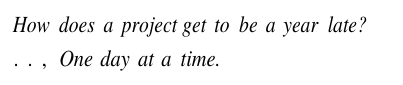
How does a project get to be a year late? One day at a time.

When I was in college, Prof. H. Narayanan told me once, “You are creative, but you should also be right!” I didn’t think much of it that time. When you like working with computers, you can’t stop appreciating how hard it is to get it “right”.

Is it possible to get hard problems right in the first or second try? Eventually yes. I mean, anyone can make good progress on anything given “enough” time with consistent effort! But if we are a startup, we don’t have the luxury of spending years. I think we can get it right in first or second attempt if you do the “planning”. You could break the hard problem down to simpler problems that your team and solve with minimal supervision. If you can’t, find someone who can!

Let me put it more concretely. Let’s say I can solve a class A problem 50% of time, class B 90% of time, and class C almost always, i.e., 99% of times. What are my chances of solving a problem if I can break it into two problems of class A, or four class B, or eight class C problems?

Class of sub-problemsChance of solving one problem of this class# ProblemsChance of solving all
A502 of class A25%
B754 of class B31%
C998 of class C92%

You have two options. Find someone who can solve the master problem with 92% chance, or find someone who can break it into eight class C problems. I always seek out the later type of people when I conduct interviews. People who can partition a problem into multiple simpler problems that can be delegated to others. These folks are force multiplier (positive compounding, that is)!

This leads to a corollary that 10x engineers are not necessary. I’ve not met one yet, let alone hiring one. There is an easier way. Search for normal devs who show signs of positive compounding. These folks are usually disciplined in some way, and excellent with tools. Add a force multiplier to the team, and you are done.

None of the musicians in the band Indian Ocean is what I’d call a 10x musician, but their work is of great quality and value. Why can’t start up teams be like that?

Managing Peopleware

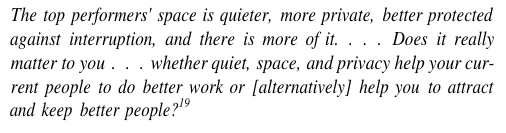
The top performers' space is quieter, more prive

A lot has been written about managing teams. You hire talented and energetic people, and they start off very well. You think everything is great but suddenly after a year or so, things are lukewarm at best. What is going on?

In case of young hires, the reason can be pretty really simple. It not always the case that management is evil. When you start a new job (or a PhD program), there is a sense of anticipation. And when you finish a hard project, there is a sense of accomplishment. At these stages, one feels good and life is good. It’s the middle years — after anticipation is over and before accomplishment — that are taxing. If you don’t want to spend time motivating your young hires then just don’t hire anyone under 30s. Though, I’d recommend hiring talented young folks but ensure that they leave for greener pasture in a year or two on good terms.

For experienced hires, perhaps the reason is equally simple. Everyone has a different set of values, and what you value most may not be on the top of their list. You may value product-market-fit and customer-satisfaction, or the next fund-raise above everything else, but the developer just wants to write Rust and clean up tech-debt rather than thinking about any of that! Can you figure out how to work with your peopleware without asking them to sort their values according to your list?

Small things also matter a lot. Programming is a form of writing, and writing is primarily a solitary activity. If someone is good at it, they must have enjoyed spending a considerable time alone learning the craft. Don’t disturb them every couple of hours by sending notifications and emails. Schedule your communication effectively. These minor irritant compounds negatively on a developer psyche, much like “Scar Tissues Make Relationships Wear Out” — John Ousterhout.

I know some very good programmers who are good at talking, and even documentation, but I haven’t seen one yet who loves being a social-butterfly all the time, and doesn’t hate context-switching.

Leadership ensures ‘Everyone Going In the Same Direction’

There is much more to leadership, but I am very much content with this view. It is effective enough for managing a project, if not the whole organization! Therefore, the primary job of team leadership is communicating to ensure that everybody going in the same direction.

While I love setting up processes and workflows, I do recognize the creativity comes from people and not from processes. So there must be some channels for expressing creativity. But beware! I think creativity always conflict with that boring thing called ‘getting things done’. Being creative is nice, but “creative thinking” or thinking outside the box always leads to a different path than what you’ve charted, else it won’t be called creative.

The hardest part for leadership is to say “no” to seemingly good ideas that could lead the startup astray. I don’t feel very comfortable saying no to people for ideas, so I just don’t encourage “creative” ideas in most of the meetings. Like a young Ph.D. student, startup will do well not to indulge into “creative” things. The benefits are imaginary if any, but the cost (time spent) is real! There is time for being creative when you’ve not charted your course.

Also, I am a big fan of incremental improvements. The important meetings must be well-structured and focused, and any attempt to steal the focus should meet with a friendly frown and discouragement.

There is another indispensable aspect of leadership which is required to overcome problems discussed in A Group is Its Own Worst Enemy by Clay Shirky. If you are in this situation, then good luck. You must act decisively or give the position to someone who can. Leadership becomes a bit like using a toilet: you either shit or get off the seat!

safety > security

The advertisements during this IPL made me realize that safety can not be ensured by striving for security only. Safety is a superset of security. You can be inside a totally secure and trusted environment, yet harmful messages (or advertisements) land in your lap. Direct or surrogate messages to consume paan-masala or bet on cricket originate from trusted people, likes of Sunil Gavaskar and Shahrukh Khan.

Similarly, your endpoint may be very secure yet remain unsafe. A malicious PDF or email can land in your inbox from a trusted source over a very secure channel protected by TLS or VPNs or QUIC channels and still constitute a safety hazard.

Safety often requires users to exercise critical thinking and good judgment. Your people should be taught how to detect scams, and they must know how to detect scams.

Scam messages often appear to come from someone you know, if your contact list has been compromised. They almost always carry an element of urgency—for instance, “Help, I have lost my wallet and passport and need funds!” or “I don’t have time to get a gift for my friend. Can you send a gift card?” Some of these messages used to play on greed and now they trade on so many people’s willingness to help a friend. Some of the worst scams prey on people grieving lost friends or family or who want to help during disasters. [1]

But what do you do when your endpoint has no user?! How do you teach your endpoint to exercise critical thinking and sound judgment? Similar messaging tactics will fool your endpoint into running unsafe code. If you can turn your endpoint immutable, then you don’t have this problem, but what about endpoints that must remain mutable to function?

It is a tricky problem to solve. Zero-trust is a strategy in the right direction (though it means a lot of different things to different people). Nonetheless, any incremental progress toward a solution will always be a positive ROI.

First, securing the network is not enough. You need an agent on the device to stop malicious behavior or force the user to make a judgment call. Second, you can’t do the “data to decision” step in the cloud—it will be too late! We at Subconscious Compute are taking steps towards a good solution—a kernel agent called Shepherd (trust its instinct).

India’s New Capitalists: A farmer & Engineer Review

Harish Damodaran’s “India’s New Capitalists: Caste, Business, and Industry in a Modern Nation” is a modern classic. I finally read it this week. Here is a TLDR from a farmer and engineer’s perspective.

The farming communities in the South, especially Kamma, Reddy from P/Telangana, and Naidus and Grounders from Coimbatore, have done exceptionally well. One of the main reasons is the “Bania vacuum” of the South. Compared to my native Western UP, where all Sugar mills and daily newspapers are owned by the Banias, the AP and Telangana factories and newspapers are owned mainly by farmers. They control their interests. I wonder why we don’t see farmers’ protests in the South.

Farmers haven’t succeeded much in the North due to the stronghold of traditional mercantile classes. However, cooperatives in Maharashtra and Gujerat have provided stepping stones. The cooperative has never succeeded in Punjab, Haryana, and Western UP; the ability to break into traditional social networks and access capital is thus highly restricted.

The book also summarizes the historical evolution of traditional mercantile classes at the port cities. Parsis need to start thinking about the harmful effects of inbreeding! You can read about this in other reviews.

A few minor annoyances: names of caste and community are thrown at the reader rapidly, and you may be unable to keep up. There is only one table in over 350 pages! The book also shies away (perhaps for good) from discussing the adverse effects, explicit and hidden, such as nepotism, corruption, promotion of undemocratic values, and eventual decay associated with social networks and community bonds.

This book was published in 2008, and I hope the author or someone else writes another one soon. The technology sector is now very well established and, like sports and politics, provides much better mobility to talent. I won’t be surprised if the South has a substantial advantage over the North. The rich folks and governments in the North have never invested in community school education like their counterpart in the South. No wonder they are voting with their feet to come to the South.

Thinking of joining a startup, consider these points

If you are early in your career and considering working for an early-stage startup (or any stage startup), consider the following points sincerely.

You are not being hired to “learn things” unless learning means solving their problems. Many folks I interviewed seem to have a strange view of learning as if it is like Brownian process. You can learn the rest of your life and don’t accomplish much. Learning == solving problems is a healthy starting point. This view doesn’t conflict with industry interests. In other words, don’t expect to be paid for learning things; you are paid to get things done.

Before interviewing, learn about the product or problem a startup is building or solving. Your time there will revolve around that. Consider yourself extremely lucky if you get to work at things you love. But you must be ok to do things you don’t terribly like. You don’t have to “love it” to get it done properly. Be professional! Also, great jobs don’t grow on trees; you have to earn them!

If you don’t value equity, you don’t value the startup game! There are not many good reasons to work at a startup (fewer to start one). Equity and working in trenches at the frontline are the only good reasons I can think of. I feel that it is okay if you only care for “here and now” things such as cash in hand, as long as you don’t take more than you deliver.

Startups may have money, but most of them usually do. But they are always short on time. If you tend to procrastinate, do not go near a startup. Everything must have been done yesterday. Speed is a virtue. Please consider again if you are laid-back and don’t enjoy the rush. There will always be a rush, and deadlines may bring out the worst in people. And if you also have thin skin, you are in a hell of a pickle!

You may have to do a lot of work you were not hired for. No startup can anticipate your role there. You may have to become a generalist rather than a specialist. Startup hiring advice: prefer generalists over specialists.

Netflix got this right: Your workplace is, at best, your team, not a family. I won’t work with my family or friends since most will be terrible co-workers. Being part of a team means always pulling your weight and some more.

Don’t go to a cricket field if you only care about batting. Your team will be better off without you, no matter how great you are at swinging a bat. In a startup, you may never get to bat and perhaps spend most of your time curating the pitch, watering the ground, and managing the gymkhana. You join for the whole game, not just for batting or bowling.

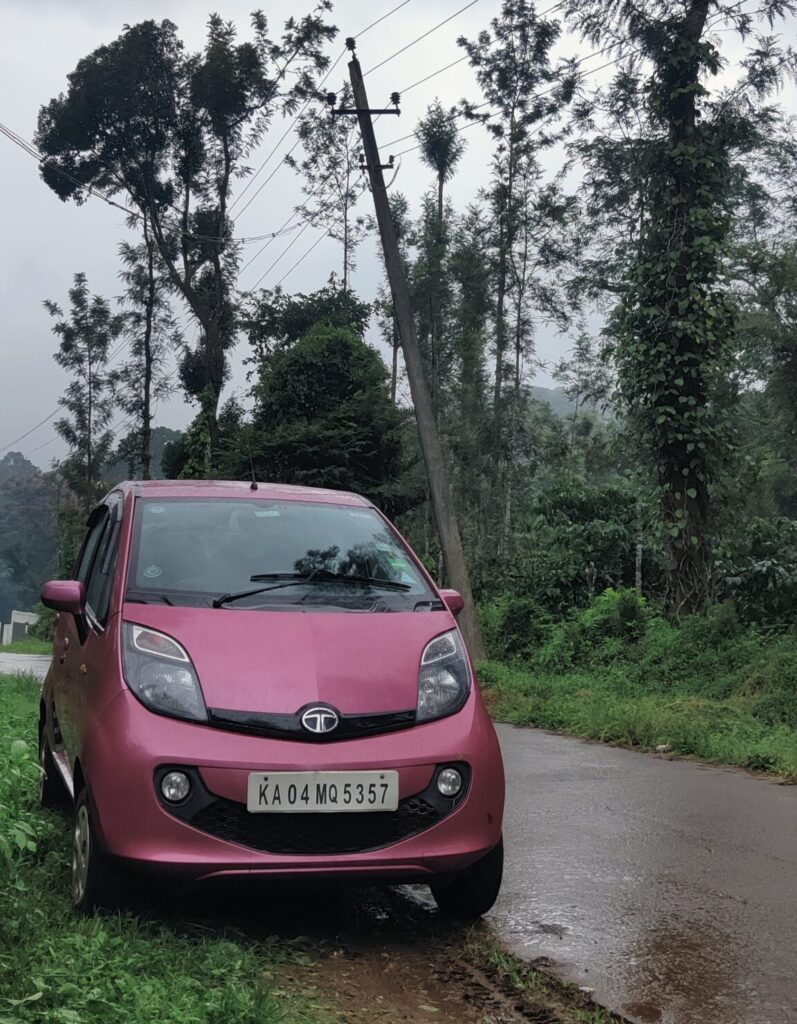
Tata Nano XTA

I bought this 10-year-old car from a local person (advertised on OLX) in 2024 for ₹230,000, when my wife was pregnant. I was also learning to drive at the time, so a small second-hand automatic car felt like the right choice.

This car has served me very well. It’s better than you’d expect it to be, though not as great as you might imagine. It’s a great car for driving within Bengaluru. It does well on long trips as well. I’ve taken it from Bengaluru to Mangalore and back, and driven it through the Western Ghats (hilly areas).

On the highway, the pickup isn’t great, so you need to plan your overtakes. If you’re comfortable driving at speeds between 60 and 70 kmph, this car is great.

Cabin AC is good. The suspension is fine but if you are not careful on speed brakers, you will feel the pain! The braking is good enough.

Inside the city, I typically get 15 to 18 kmpl mileage which go up to 25 to 28 kmpl on highways.

Politics Of Resentment

The disintegration of the Congress party over the last few decades is well-deserved. Many factors have contributed to this disintegration, including corruption, indiscipline, and the sheer ineptitude and lethargy of its aging leadership. Fortunately for the Congress, the old eventually die. The condition of Congress seems to be improving lately. In particular, its leadership’s paralysis in the face of even the most trivial sorts of crises in interpersonal relations has been improving. The success of Congress in the 2023 assembly election in Karnataka has been ascribed to this which is welcome news for Indian democracy.

The BJP has done remarkably well in last few decades and most of its success is not because the Congress is weak. BJP even managed to resonate with people outside the Hindi heartland, especially in West Bengal and Karnataka. I found BJP’s success in West Bengal quite surprising. A state that was in the firm grip of the Left party’s culture for over 3 decades now votes for BJP in large numbers! The vote share of the BJP in Karnataka is also very impressive.

20 years ago, If I were to sum up the BJP’s political culture in a single phrase, it was ‘*Hindu bano, Hindi bolo’*. I first heard that phrase when I was in school from an RSS pracharak. Though they started this slogan in the aftermath of the Emergency. In the great Hindi-speaking region of the country, it has an immediate appeal for all political parties, but it is the BJP that can articulate the sentiment behind it most effectively. The Congress has a different past which it cannot shake off very easily.

If it were only a matter of Hindutva (*Hindu Bano)*, the BJP would be able to spread its influence without too much trouble. After all, more than 80 percent of Indians are Hindus, of one sort or another. What would be the problem in adding Shiv and Durga, or even the Pir Satyanarayan, to Ram? But persuading people to embrace Hindi may be more difficult than persuading them to remain Hindu. Most politicians of South India, including BJP, will be more at ease in a Hindu temple than at a political rally where all the slogans are in Hindi. And this may be true for the vast majority of Indians outside the Hindi heartland.

Whereas Hindus make up more than 80 percent of the population, Hindi speakers do not add up to more than 40 percent by even the most liberal estimate. This must surely be a source of anxiety to the leaders of a political party identified so closely not only with the Hindu religion but also with the Hindi language. Mr. Narendra Modi, a Gujarati, may have succeeded in taking the attention away from the Hindi chauvinists for the time being, but I don’t think he can [keep them under control for a very long time](https://www.outlookindia.com/national/stalin-flays-hindi-for-jobs-proposal-of-parliamentary-panel-news-230335). Will they not do something about it that will give their party a different direction and a different image? I believe that they can do very little. In the age of mass democracy, it is easier to alter a party’s political programme than to alter its political culture.

Secularists liked to frighten themselves with the thought that as soon as the BJP comes to power in New Delhi, it will start a massacre of the Muslims. That has not happened so far but some of their fears had been justified. BJP doesn’t seem to have either a radically different economic policy or a radically different foreign policy. What the BJP has succeeded in hitting the hardest — in addition to democratic institutes — is education where, apart from the opportunity to distribute patronage widely, there is the bonus for demanding the expulsion of English. ‘Angrezi hatao’ expresses [hostility not just to the English language](https://www.theguardian.com/world/2022/oct/22/modi-employs-new-tool-in-indias-war-against-the-english-language-hindi-medical-degrees) but to a whole system and [method of education](https://www.nature.com/articles/d41586-023-01750-2).

Fortunately, education is largely a state subject, so whether or not the BJP remains in power at the center, the damage will not be equally extensive everywhere. The principal targets of attack will be those things that stand for progress and modernity in education and culture. This will affect economic development only indirectly, and its adverse economic effects will not be visible in the short term. Those who feel threatened by liberal modern culture are by no means all averse to the material gains from improved technology and more profitable international trade. And they will continue to be no less hypocritic in the future as they are now.

The politics of BJP, above all, is a politics of resentment. In India today, there is resentment against a great many things, not just the Brahmins or even the upper castes. That has now become a general feature of Indian politics to the extent that the tone and language used at national or state level politics is hardly any different than the one used during local panchayat elections in my village. The language of politics in the country today is the language of resentment. This style and language have acquired a particular emphasis in the Hindi heartland because of its backwardness where it far more easier to mobilize the masses causing resentment. Here the BJP has a clear advantage, for its target of attack is not just Islam, but the modern world, including its secular intellectuals.

Personal Accounting and Budgeting Apps

I was looking for an easy solution for budgeting and accounting. I did a Reddit search, and <a href="https://www.reddit.com/r/IndiaInvestments/" data-type="link" data-id="https://www.reddit.com/r/IndiaInvestments/">r/IndiaInvest</a> was quite helpful.

I shortlisted two apps from the search: Wallet from Budgetbakers and FinArt. Both of them are pretty new in the market. Both are feature rich. I did a feature comparison. I finally chose Wallet over FinArt.

Wallet from Budgetbakers FinArt
Does it have a web app? ✔️But advance features are in mobile all. Still very decent. ❌👎🏾
Android App ✔️ ✔️
How do I import data? It sync with bank. Supports many bank. Also allows uploading XLS/CSV and of-course manual entries🙄. Reads SMS and create sheets from them. It is a both bug and feature. Doesn’t require syncing with bank. Much easier to get started.
Data Backup You can export data from Wallet in CSV/XLS format. No automatic export as of now. 💯 Sync with Google Drive as a simple CSV File.
Privacy GDPR compliant. Based in Europe. Reads your SMS! Even when syncing with their database is opted-out, they send merchant information to their server👎🏾. Hope they change it in paid version and also play fairly.
Price $28, Rs. 2250, for lifetime. Yearly plan available too. Rs. 800 per year.
Advance features Automatic rules to label transactions. Didn’t use long enough to explore all the features.
Family support You can add multiple accounts and have one dashboard for family. Bank must be able to sync. Connect to the same WiFi and it can read SMS from another device.

I hope Wallet from Budgetbakers implements periodic Export to Gdrive or Export to Nextcloud soon.

What I am looking forWallet from BudgetbakersFinArt
Does it have a web app?✔️But advance features are in mobile all. Still very decent.❌👎🏾
Android App✔️✔️
How do I import data?It sync with bank. Supports many bank. Also allows uploading XLS/CSV and of-course manual entries🙄.Reads SMS and create sheets from them. It is a both bug and feature. Doesn’t require syncing with bank. Much easier to get started.
Data BackupYou can export data from Wallet in CSV/XLS format. No automatic export as of now.💯 Sync with Google Drive as a simple CSV File.
PrivacyGDPR compliant. Based in Europe.Reads your SMS! Even when syncing with their database is opted-out, they send merchant information to their server👎🏾. Hope they change it in paid version and also play fairly.
Price$28, Rs. 2250, for lifetime. Yearly plan available too.Rs. 800 per year.
Advance featuresAutomatic rules to label transactions.Didn’t use long enough to explore all the features.
Family supportYou can add multiple accounts and have one dashboard for family. Bank must be able to sync.Connect to the same WiFi and it can read SMS from another device.

FinArt has a good UI, and I would have preferred it if none of my banks synced with Wallet from Budgetbakers. I was alarmed that someone was reading all of my messages, though. But I think this app has a lot of potential especially in our country where most banks won’t provides API to sync transactions. Rs 800 per year is not a bad price as long as they deliver a first-rate product. It is roughly $35 per year (in purchasing power parity terms).

I am enjoying Wallet from Budgetbakers and have been promoting it in my circle. So much so that I’ve changed my salary account back to HDFC bank from DBS Bank. I was disappointed in DBS bank that it didn’t sync (only current accounts can be synced). Also, the CSV export from DBS bank was terrible with many unreadable characters 🤕. As a bank that prides itself on being tech-savvy, this was a very embarrassing situation since I was singing their praises in my circle.

Kaalu and Viral Papilloma

Our dog, Kalu The Fifth, had some viral growth at her mouth recently. We noticed it in late January 2023. The vet says that it is caused by Papilloma virus. It causes a very common condition called warts. Warts in Dogs.

Wart on January 31, 2023. It was 8mm in diameter. On the right is another picture on the same day. This wart is caused by Papilloma virus is usually harmless. This virus doesn’t spread to humans!


papiloma_signal-2023-03-03-071602_002.jpeg

The vet suggested two options: surgery or homeopathic medicine. I was surprised that a proper doctor suggested the second option, as it is no better than a placebo.

After reading a bit more about it, I learned that a dog’s immune system is not fully developed until they are two years old. As Kaalu is only 13 months old as of today, I decided to watch the wart for few months and keep track of its growth.

On January 31, 2024, the wart was 8mm in diameter. A month later, on February 28, it had grown to 13mm in diameter. Kaalu had no issues with it, but the other street dog, Jumi, was trying to nibble on it. Jumi is such an idiot.

A few days ago, I was considering surgery for the wart. However, on March 3, 2023 I noticed that the wart is almost disappeared. Kaalu has kicked the ass of Papilloma. And since new cells were not added to the growth, the wart did not last very long and collapsed within a few days.

If I had started the homeopathic treatment that my wife suggested and the wart had disappeared like this, the credit would have gone to — drum rolls! — homeopathy, despite it likely being a coincidence.

p_3signal-2023-03-03-072223.jpeg -- Wart on Feb 26, 2023

Tech I’d Like To See: Non-Newtonian Cognition For Machines

Last December, I wrote a short piece for the Times of India (ToI) in a column called “Tech I’d Love to See”. It took a while before the article was printed. On January 25, 2021, someone I know sent me a message on LinkedIn about it. I couldn’t find it online or with the search engine. The ToI website wasn’t very useful either. I was able to find it in their e-paper.

signal-2023-01-25-170005_002.png -- My opinion piece in Times Of India

“Non Newtonian Cognition For Machines”, published Jan 25, 2022, Times of India.

From Almost Zero To Five Kilometers (And A Half-Marathon)

I started running seriously on July 16, 2021, during the Covid lockdown. I had graduated, and I could no longer walk or cycle to the lab daily. And I was working full-time and very long sessions on my six-month-old startup, and these long programming sessions were taking a toll on my health. I needed a routine to sweat daily.

I enjoy cycling. I need at least two hours of sessions per day to feel like I’ve had a good ride. One day of cycling a week didn’t cut it. My muscles were getting stiff, and I wasn’t sweating daily, which is one of the best stress-busters. I turned to running, something I wasn’t really fond of during my Ph.D.

I occasionally cycled and hiked in the Western Ghats. I tried playing badminton to sweat daily but never running. I used to joke with a few friends who went running, “Hunter-gatherers run, not scientists!” and “What’s the point of running after all this scientific progress? Can’t we go cycling? The best combination of machine and muscle!” I tried swimming, but I couldn’t learn how to breathe properly before the lockdown, and access to the pool was very limited during the lockdown.

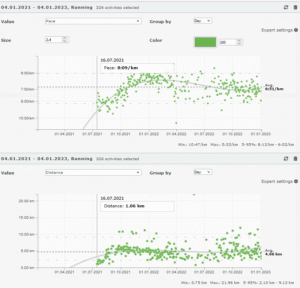
Starting was tough. But I went out every day and ran as much as possible, which was very little. In the first week, I was running between 1 and 2 km. I was aiming for mileage and not pace. This strategy helped a lot. I joined the Subreddit r/runningng. It’s a great community. I also read many blogs about running 5km from zero. 5 km was the target.

All of my recorded runs so far till January 4, 2023. My pace improved by the end of 2022 when I hit almost 6 min/km pace. Then I slowed down because I was giving company to some of my friends who were starting to run. I had a bad summer in 2022 (running-wise) though I did a half-marathon on July 17, 2022, in Munnar, Kerala. I recovered in the winter of 2022 and finished 1000km in 2022💪🏽🎉.

All of my recorded runs so far till January 4, 2023. My pace improved by the end of 2022 when I hit almost 6 min/km pace. Then I slowed down because I was giving company to some of my friends who were starting to run. I had a bad summer in 2022 (running-wise) though I did a half-marathon on July 17, 2022, in Munnar, Kerala. I recovered in the winter of 2022 and finished 1000km in 2022💪🏽🎉.

From almost zero to 5 km

In my first 15 days of running (July 2022), I went out nine times (total 15.5 km, min 1 km, max 2.3 km) and cycled one time (60.2 km). I am a bit surprised that I went out nine times in the last two weeks of July! I must have felt really good after sweating. I think I do slow starts but remain consistent.

My first two weeks of activities. Nine runs and one cycling trip

On August 16, 2022, I ran my first 5 km in 41 minutes. I was not planning to run 5 km that day. I was touching 3 km for a week before this day. I can’t remember what was pushing me to finish 5km. I was very proud! I think I zoom-bombed my old lab’s lab meet just to tell everyone that I ran my 5km🥲.

It took me a month to go from almost zero to 5km.

First 10 km

On August 27, 2022, I ran my first 10 km. It had been two months and ten days since I began running seriously and one month and ten days since I completed my first 5 km. I put a lot of effort into it and was exhausted afterward. I had a slight fever and slept like a log the entire night. I didn’t brag about my 10 km accomplishment as much as I did about my 5 km😊.

Half marathon

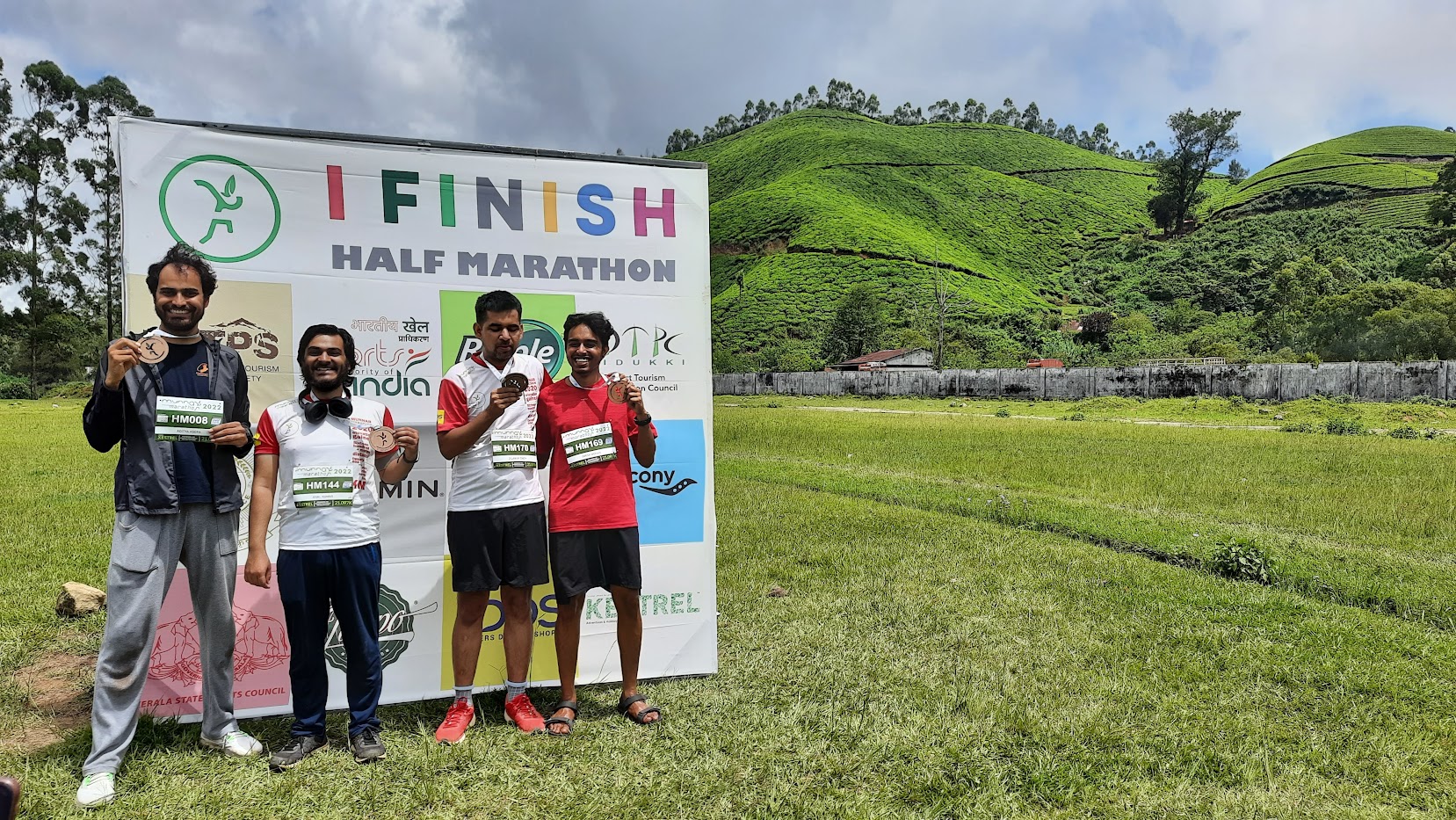
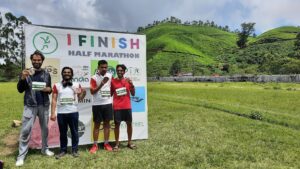
Aditya, who often does half-marathons and marathons, told me to sign up for one. One in Munnar was coming up. So there was a chance that I could hike as well. We took our coworkers from the office to a homestay in Munnar. The trip wasn’t the best for everyone because of all the traveling. Four of us ran the half-marathon. The route was beautiful, but the roads were bad. You could still see the effects of the floods that happened in Kerala a year ago. I barely completed it; I mostly walked the uphill parts. It took me almost two hours and 30 minutes to finish.

IMG_20220529_111816 -- Almost at the end of the marathon. I was barely lifting my legs though my heart was doing OK

20220529_111202 -- Aditya, Anal, Me, And Girish after finishing the half-marathon. Anal was last to finish. He read a few articles while running. My legs were sore after the running.

I think I have developed a taste for running. I am planning to run 40,010 km before I die. That is the circumference of the earth passing Bengaluru.

The benefits of running are clear. Unlike other sports, you don’t need anyone else to do it, and you can run whenever you want. It also lets you sweat a lot in a short amount of time. Your body will get used to it and want it more when you keep doing it, like with any other exercise.

There is also Newton’s third law of inertia. When you haven’t been running for a while, you don’t want to start again, and when you do it regularly, you don’t want to stop. Nowadays, if I don’t run for two days in a row, my body starts asking for it.

Personally, sweating has been the most important part of my exercise routine. It makes me feel good throughout the day, and my mood is significantly better. My programmer’s body also likes it; my shoulder pain and wrist stiffness have gone away after four months of running.

I don’t think running is a complete exercise; my upper body is still as weak as ever, but I don’t care too much about it. And developing a routine also has its benefits.

Tools

I used an Android phone and the Runnerup app to record my run. I had a MI watch, which was costly by Indian living standards, to record my heart rate and other data. However, I disliked their official app. The Runnerup app could use the heart data from this watch. After the recording was complete, it uploaded my runs to Strava and Runalyze (https://runalyze.com/dashboard). I am very fond of the Runalyze platform. Its free plan is sufficient for my needs. Anyhow, I cannot afford their monthly plan.

Running-2022-all-heatmap-4000-20230103-1745-25d9.png

Running-2021-all-heatmap-4000-20230104-1457-4dc6.png

I often use GOTOES to add times to a GTX file. Occasionally, due to power-saving settings, the recording fails and I must manually trace the route and add times before uploading to Strava and Runalyze. There are other features on this site that I haven’t explored yet.

I haven’t made any special plans for running. Maybe I should get a massage after running and do some stretching before running, but I’m not sure.

Spaying Kalu the Fifth

Yesterday (August 27, 2022), we spayed our dog Kalu The Fifth at the Pet Connect Hospital and Shop. She is 8 months old. The ideal time for a dog to be spayed is a few weeks before she is expected to be in heat. When we took her to the vet first time, she was already in heat. Vet asked us to come back a few days after her bleeding is over.

On the day of surgery, she needs to fast for at least 12 hours. Her surgery was scheduled for 11 am. We gave her dinner the night before the surgery at 11 pm and took her to the vet the next day at 9 am. She was hungry the whole morning but didn’t complain too much. She enjoyed her walk to the hospital very very much. It went through the streets, railway lines, and muddy roads near construction sites. I had to lift her a few times to avoid her enjoying herself way too much in puddles. My wife was a bit irritated for not taking the normal road or the auto.

In the clinic, when the nurse try to take her blood out, she almost bit her and me as well. This time she did not like folks in the hospital a bit. Probably because a few dogs were barking there and it made her tense. I took her out for a walk and she calmed a bit I put a muzzle on her. He bit the muzzle a few times when I was trying to put it on her. In the end, I succeeded. She was mad! Always put the muzzle on the dog before entering the hospital. You can’t control everything around your dog and she might bite someone.

They took the blood sample. Surprisingly, most dogs there didn’t react to the needle. When the nurse put the needle in her veins, I didn’t see any expression on her face that said she was in pain. She also didn’t make any sound when the needle went in. Probably they don’t feel the needle as much as we do. As soon as the nurse took the blood and went away, I removed the muzzle and we ran out of the hospital only to be returned by 1 pm for the surgery (if the blood report didn’t show anything that means no). It’s been a very odd day for her😕.

The surgery

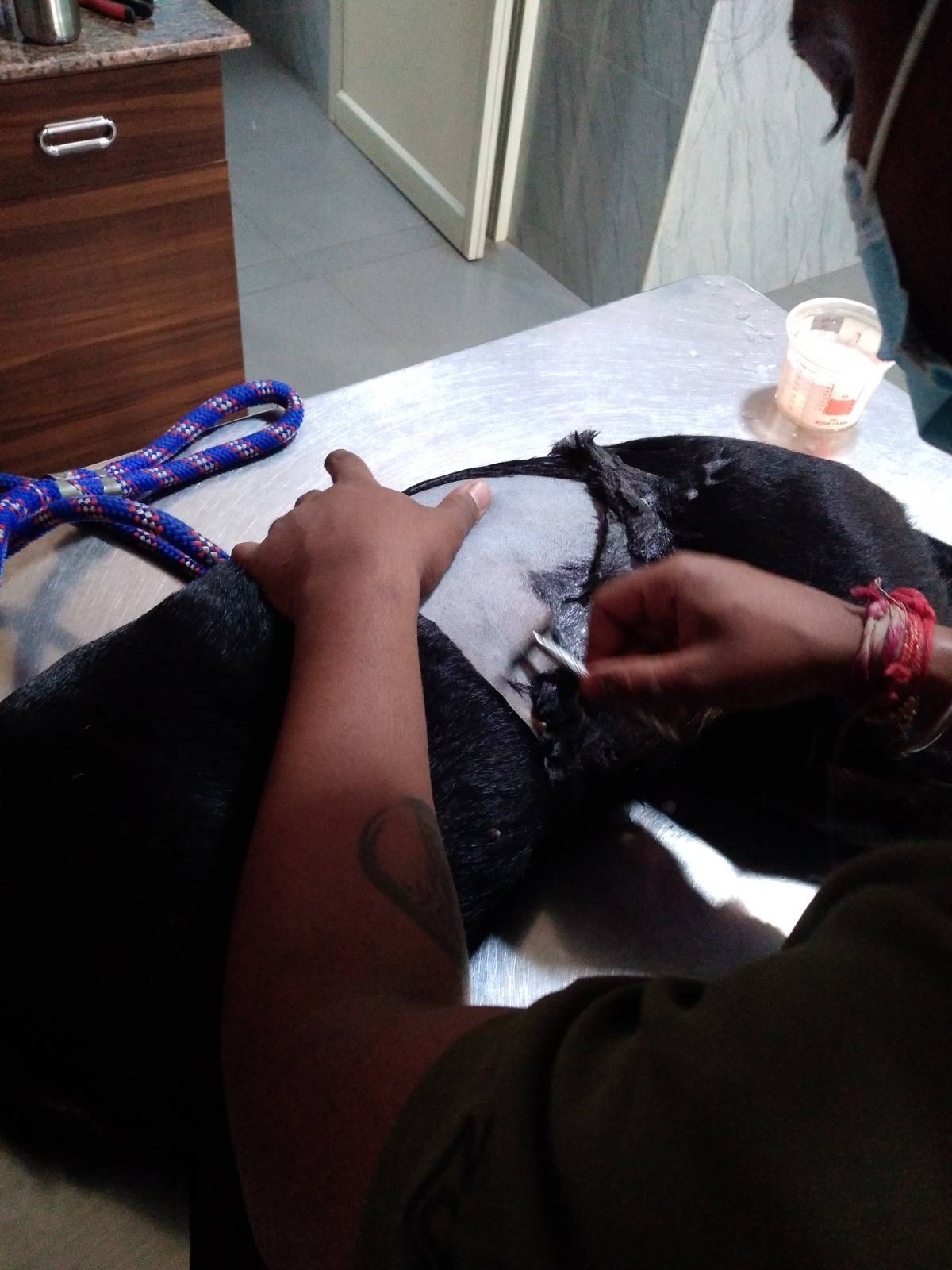
Before we walked into the hospital at 1 pm, I already put the muzzle on her. This time she let me put on the muzzle without much protest. Phew! The nurse gave her a sedative and we removed the muzzle ten minutes after the sedative was given. Most dogs would vomit after sedatives. She did too. The nurse shaved her a little around her tummy before the surgery.

  • 0b11e201e8814460bd36a26979fee195
  • ddfa630623ab439ca9e6bd31363e6202 -- Kaalu the fifth before surgery

Before the surgery, the doctor asked us to sign the consent form and asked us which sedative we’d like to use on her. There were two choices of sedatives. One is injected into the blood before the surgery. Once given, there is a fixed time after which the dog wakes up. There is not much control over it. The other option was to give sedatives mixed with breathing air. You can stop the sedative after surgery is over and the dog wakes up in a few minutes. We chose the latter. It is a bit costlier as well: Rs. 2000 extra.

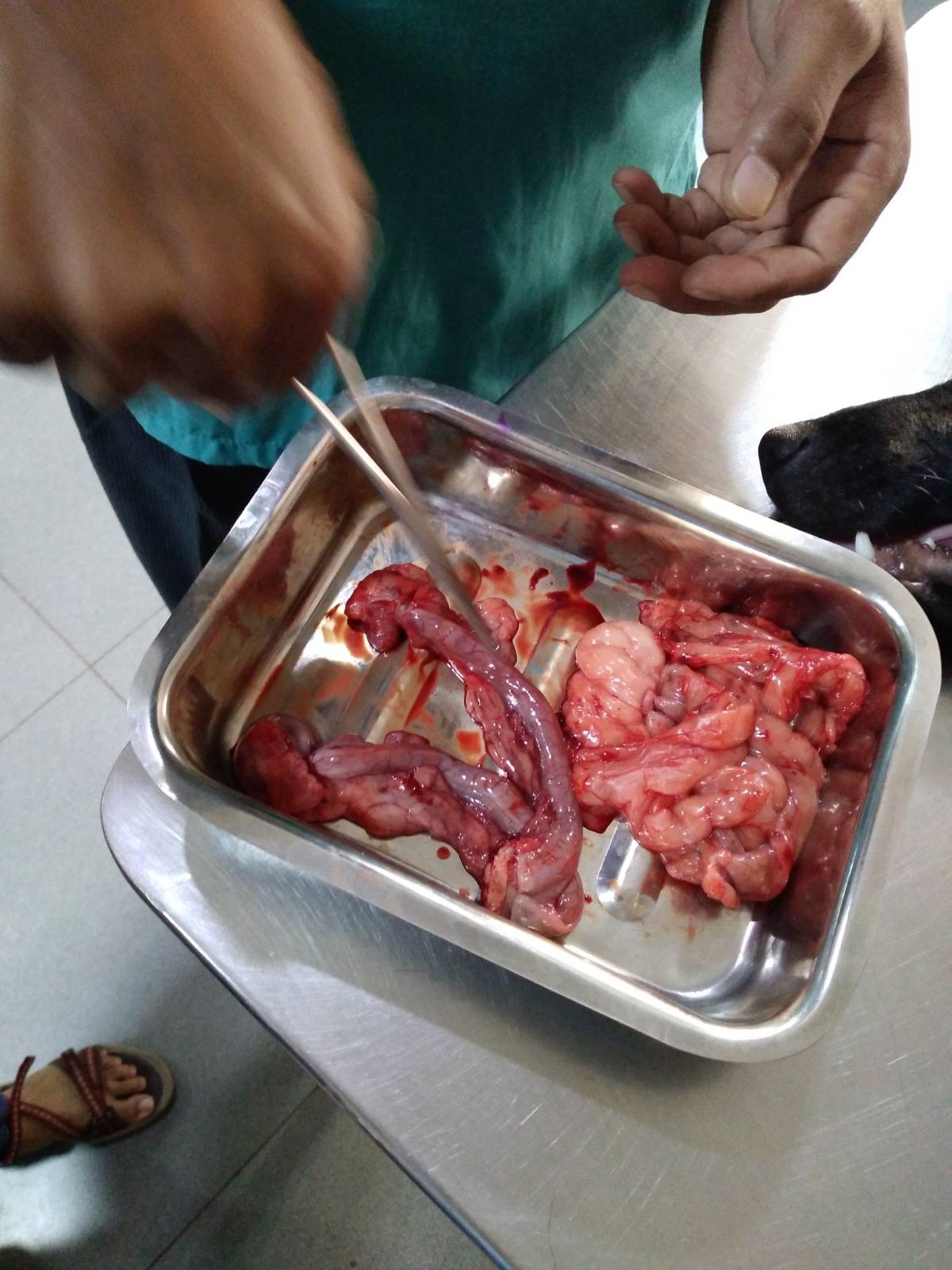
The surgery lasted for 40 minutes. That’s the typical duration. They removed a few organs from her. The doctor offered to show us the removed organ. Honestly, I didn’t know that organs were removed🤷🏾‍♂️. I thought that they make cuts inside so that sperm or eggs don’t meet each other.

ab4fc7de7a8b4435a01e4bb63d8cefb2 -- Kalu after the surgery. Still unconscious but breathing normally.

Kalu after the surgery. Still unconscious but breathing normally.

ba465e1032ab4b32acc0a41a78e94b82 -- The removed organs: ovary and uterus. There are two of them in this container. The other one is from a larger dog.

The removed organs: ovary and uterus. There are two of them in this container. The other one is from a larger dog.

When Kalu finally woke up she was in shock and try to jump out of the table. She was terribly confused as one should be. I tried to hold her and calm her down. Another mistake. Because in the stage of confusion, she could have easily bitten me or someone else. Fortunately, it didn’t happen, and the nurse put a cone on her. We brought her back home in an auto. She was in discomfort but not in pain.

I put her on the sofa. She peed all over her in the hospital and part of my shirt was also soaked in her pee. She became very calm as soon we were close to home: her familiar place. She slept on the sofa for an hour. We gave her some water when she woke up. Anu bought some tin food (most likely fish) for her from the clinic. She at a little bit of that too. During the evening, her body temperature was going up and down. Her nostrils were sweaty so I didn’t bother too much. She was also struggling with the e-collar she has to wear for the next 8 to 10 days. Oh well!

I lifted her from her chest and she felt the pain. I put her down on the soft and try to pat her head to calm her down. But she was still mad and she tried to bite me in a way that she never did before😔.

After a day of surgery, she is recovering well💪🏽. She has started behaving normally. Though she has not pooped in the last 24 hours. When Rocky — a friendly dog from the neighborhood — came to the house to play with her, she was in shock for a while. She sniffed Kalu slowly but kept her distance. She is not the Kalu she knows. Anyway, she can’t play (too hard) for the next 3-7 days. By then I hope Rocky will also be willing to play along.

Update: She behaved so well in the cone that we removed the cone after 3 days of surgery. She never licked her wound or tried to remove the patch that was on her skin. After removing the cone, Rocky started playing with her normally. Her health is normal and surgery doesn’t seem to impact her mood in any way.

Farm Bill: Err on The Side of Caution

My father is a farmer. He works and lives in western U.P., a relatively prosperous area in terms of groundwater and road connectivity. He is not sufficiently poor. He managed to pay for my college (circa 2007). I spent the first 21 years of my life in the village, often working on the farms. It is a hard life once you have experienced the alternatives.

We are sugar-cane farmers and are well organized. Usually, politicians don’t like to mess up with organized farmers. But a hyper-centralized state can. After all, everyone is living in their own bubbles these days. Some people, powerful or not, always believe that they know what is good for everyone else. This is not true even when they have the noblest of intentions and act in good faith. And this bill was not passed in a good faith.

We wouldn’t know the effect of this bill for a year or two. Strong fluctuations in prices is a routine for farmers, especially near harvesting season (can’t tell why!). But there is something odd about
this bill. Like demonetization, GST, and CAA, the long-term benefits of this Farm Bill are doubtful at best (call me anti-national), but the short-term dangers are real.

Let’s consider the simplest possible scenario. I spend 3 to 4 months on my rice or wheat crop. During these months, I paid school fees, medical bills (not all days are achche din) often by borrowing money from a local money-lender at an interest rate of 15% to 50% per annum (what? That can never happen in our glorious country. I must be lying! After all, the best government is at the helm. Off with an FIR!). As soon as I harvest my crop, the first thing on my mind is to pay back the loan and plan for the next crop. I can’t store for a very long time or delay the payment on the loan even if the loan is from a Sarkari bank. I am not Ambani, Adani, or that Kingfisher guy (I am sure this list is long!).

The local vendor (khalifa) comes to my village and offers me a price which is usually less than the minimum support price given by the govt. He picks up the crop from my house. Saves me the time and hassle of transporting the crop to the Sarkari mandi which is at least 30km away. Selling in Mandi usually means waiting in the mandi for at least one day, and for a couple of months for the money to arrive in the bank. And no, you still don’t get SMS when and if the money arrives in the bank.

If the vendor offers me 10 to 15% less than the Sarkari price, I happily sell it to him. If he offers less, I take the trouble to go to Mandi, usually in a group of 4-5 farmers. Unlike what others have been
telling you, farmers always had the choice to sell their corp to anyone. This bill brings nothing new in this regard! Isn’t it obvious? I’ll sell anyone who offers me MSP. The question has always been at what price? No vendor has ever, ever, offered more money than the MSP!

If all local vendors lower the price for a month or two then only a few farmers would be able to wait and watch till prices go up again. Almost all farmers will go for stress selling. It is worse for farmers who grow perishable crops like tomatoes and papaya. They can hardly wait for a week. It is not a hypothetical situation to malign the reputation of your favorite politician. It happens all the time: just talk to a real farmer in good faith.

Let’s take a leaf from your life and talk about education and health. You must have had some experience with these two sectors. I see them somewhat functional in the cities and towns, much better in the southern part of the country. These sectors have roughly the same social and economic dynamics and roughly the same arguments about public and private ownership.

If your local government school is bad, I bet, most private schools are only slightly better. Aren’t they? There is no incentive for a private school to do much better than the best government school in the locality. They do slightly better and get enough candidates. Not sure what is the situation is with your hospitals. My guess is that private hospitals need to do just slightly better in diagnostics but has to look much better (they have color TV at reception). I read all the fantastic stories about how nicely and humanely they treat their patients! Why would you think farmers will get any different treatment from similar corporates entities?

The government should strive for a decent baseline: MSP for crops, minimum wages, minimum education, and minimum health coverage, even when the private sector is helping and not exploiting the lack of government presence. This is not too much to ask from a government for its people, democratic or otherwise, left or right, sikular or fascist. And every decent society should strive for it.

The MSP is set at 1.5 times the cost of growing the crop. The real market can’t afford to give this much to the farmers hence the MSP was proposed in the first place. If you think that market must be able to pay that much or more then it does not matter if you leave the MSP alone. If you think the market is fair, then it wouldn’t matter if you leave the legal provision for appeal in the court there (it won’t ever be used). Even if you think, these are needless in your somewhat utopian view of markets, my request is to err on the side of caution.

Attraction of Factions

There has been disagreement over what constitutes the basis of Indian society: caste or class. Both are very significant in our collective social life. However, a large part of our private lives is governed neither by caste nor class, but by factions. Factions are easily visible in the political domain, often forming around influential people in a political party. They are not limited to politics, but can be found in many other areas of our social life. Political scientists have paid attention to factions, but it doesn’t look like hat our sociologists have done significant empirical or theoretical work on them.

When not much data is available about a social process, people look to their own life experiences and common sense to understand the problem. Rural life — of which I have first hand experience — is simpler in terms of its organization. What matters most is personal relationships; rules are not as important. Since the community is small, this works well. People are able to take finer personal distinctions into account when interacting with each other. They turn to their relatives for both work and fun. In return, the family offers security to its members. I’m not saying that family and relatives always help each other, but they feel a strong moral duty to help and a moral right to ask for help.

Life in cities is different in scale and arrangement and is mediated by different kinds of institutions. The British introduced many new institutions into our country in the past, and, in our zeal for modernization, we have added some more since then. Whether we have the experience and ability to manage them or not, we cannot imagine our lives without them. Institutions in urbane India are supposed to work via impersonal rules and procedures. Still, it goes without saying that these rules do not count for much in most of our institutions. This is due to two main reasons: first, we did not have a tradition or “habit of hearts” which prefers “rules” over “people”, and second, the conditions do not exist in our institutions where such a tradition can grow and sustain a life of its own (See also Rule and Person).

If we are to analyze factions, we need to discard two widely held beliefs about them. First, that factions are essentially a by-product of peasant mentality, and their presence in white-collar professions or in the urban middle class is a traditional residue. And they are bound to disappear with more industrialization and modernization. Second, factions appeal to our baser nature and have little or no moral legitimacy whatsoever. If anything, I would argue that the appeal of factions is most intense in urban middle classes, and they are not without a moral legitimacy, whether or not we are willing to admit it in public. Perhaps the reason behind this is that we notice factions among others easily but fail to recognize them among ourselves.

We can learn a little more by looking at how an Indian in a village copes when he is confronted by a modern institute that supposedly runs according to impersonal rule. For a villager, a place where unknown people do work through impersonal rules is a scary place to be. Whenever he has to deal with such places – banks, police, hospital, etc. – the first thing he would inquire is whether he can find a person he can find some factional ties. If such a person does not exist, then the idiom of kinship needs to be extended. If a bank manager, doctor, or revenue officer happens to be from a different caste but from the same or nearby village, then the idiom of kinship is extended according to the village, even though everyone knows that kinship cannot exist between different castes.
On the other hand, if he is from a distant village or town, he will inquire about his caste and extends the idiom of kinship accordingly. It is this fluid nature of the idiom of kinship which enables villagers to find “connections” to get their work done in modern institutions. They must do it since they cannot be certain if their work will get done through written rules and procedures only. Also, factional ties appeal to them because it relieves them from the impersonal world of modern offices and brings them psychological relief by bringing them closer to their kinsmen — a sort of pseudo-family where an Indian feels truly secure.

The attraction of a faction (or a pseudo-kinship) is no less strong in our cities. The idiom of kinship is even more fluid among urban Indians. In colleges and universities, it can be extended to hostels, wings, batches, labs, and even to departments, not to mention academic lineage, if one has one worth mentioning. One can witness some of it during elections in IIT Bombay. Voting takes place on factional lines: wing, hostel, department, batch, etc. One notices many similarities here and voting based on “jati” in villages. In NCBS Bangalore, attendance patterns in journal club meetings depend largely on labs. Many attend the club meeting only when their own lab member is reading a paper. This pattern is often broken by the presence of faculty members, usually perceived to be authoritative figures on Indian university campuses.

The conditions and environment in which our institutions operate are both uncertain and malleable. In the face of uncertainty, people turn to their factions because there is nothing else to rely on. The rules won’t work or won’t work fast enough. The malleable nature of institutions offers vast opportunities to manipulate personal relations in factional ties. Once a pseudo-kinship is formed and acknowledged, one feels free to ask for some patronage or favor. It is remarkable how far people in positions of power in this country are willing to go to fulfill these requests for patronage. There is always some potential for material gain in all this, but one does it for the sheer satisfaction and social prestige it brings. In our society, a man in some position of power who does not offer patronage to his kinsmen is a man of no consequence.

The distribution of patronage among his kinsmen by a person in power has its own moral legitimacy in the traditional order. Nirmal Kumar Bose, the first generation of anthropologists, wrote about factional ties in the city of Calcutta; how city life was riddled with factions or ‘dal.’ These factions tried to outdo each other on public occasions with a lavish display of wealth. The wealth spent on these occasions was mostly private wealth. In recent times, the democratic processes in the country have made it possible, and to some extent even legitimized, to squander public wealth for factional displays of might and status.

The attraction of factions does not appear to be weaker, even in the most efficient sections of our society. It is remarkable that a person who appoints someone often feels that they now have a moral claim on the appointed one’s life-long loyalty. Perhaps the appointed one also feels that such a claim is morally justified, if somewhat uncalled for in the given institutional settings. What may appear to be a faction without any moral legitimacy to an outsider is, in fact, a humane arrangement of interdependence, loyalty, and security for its members.

The inefficiency in our institutions largely, if not solely, depends on the fact that the impersonal rules by which our institutions are mandated to govern themselves are either discounted or simply ignored. Discarding these institutions because they are now withering away in our tropical environment would not yield any gains. We need to rethink and appreciate the role of impersonal rules in modern institutional settings. Many of us with strong factional ties would agree publicly that impersonal rules must count for much in our institutions. However, not many of us are willing to give up the convenience of “cronyism” and “factionalism” that comes with it.

Many Indians seem to have realized the costs that some of our political institutions have to pay for accommodating families into them. However, it does not appear that we are too concerned about factionalism. In fact, many people are trying to paint a more humane face onto them [1]. If we are truly troubled by the sorry states in which we find our institutions today, we have to understand that factions (or pseudo kinships like IITians, Bengalis, Jats, Delhites, IASs etc.) – whatever advantages they bring to individuals – cannot have the same moral claim as real kinship. In the long run, factions are parasitic in nature, and a parasite cannot thrive unless it feeds on its host.

[1] Gurucharan Das and S Gurumurthy can be taken as two examples. One of them recently argued that, ”Instead of morally judging caste, I seek to understand its impact on competitiveness. I have come to believe that being endowed with commercial castes is a source of advantage in the global economy. Bania traders know how to accumulate and manage capital. They have financial resources and more important, financial acumen.”

Brief review M Tech program in Microelectronics & VLSI at IIT Bombay

I took my Master of Technology in Microelectronics and VLSI in the Teaching Assistant category from IIT Bombay between 2007-2009. Although project work is an essential part of this program, it is more or less a taught degree. In the first two semesters, one is expected to do a certain minimum amount of course work and contribute to a project alongside the course work.

The first two semesters prepare students for their project, which they are expected to contribute to in the final two semesters. The former is assessed through examinations, while the latter is assessed through project reports and presentations. When I was a student, we had to give a presentation every semester (a seminar in the first semester and a progress report in the other semesters). This has now been reduced to one presentation per year. Students spend more time reading and writing for exams than working diligently on their project, although there are notable exceptions. Sometimes one wonders how so many people who excel in coursework are so poor at their project.

Since IITs are expected to train manpower for industries, I guess they are not very alarmed at the low quality of work done in the projects. In any case, most of the students come from second-tier institutes, so they cannot contribute much to research problems even if they want to early in their program. The most sincere among them usually learn a lot. The dual-degree (B.Tech. + M.Tech.) program was designed to accommodate a better research project, but the quality of contributions made by dual-degree students is hardly any better than contributions made by M.Tech. students in general.

Microelectronics and VLSI is all about circuits on or in silicon. They teach you the basics of semiconductor physics and the mechanisms and models by which semiconductor devices can be fabricated and analyzed. Since they have a decent lab, they also teach you how to fabricate them. Designing is usually done on computers, so logical circuit design using a computer is also a part of the program. Some computer languages to describe and simulate the circuit using a computer, such as Verilog and VHDL, will also be there. You may also audit some courses in other areas as well.

If you are looking for an industrial job, then the Indian Institutes of Technology (IITs) provide many opportunities. If you are not confused about your career choices and are inwardly convinced that academic life is a good life, then you might like to explore some lesser-known research centers with a better academic culture. However, it is important to do a background check before joining any institute (if you have a choice). Try to do sincere work in your project; there is nothing better than “learning by doing”. There will be many in your class who love to make fun of those who are sincere and upright in their academic life; their philosophy of life is the philosophy of “trivialization”. They are yet to figure out what, if anything, is important to them. It will do you good if you learn to ignore their influence, if not their company.

Rule and Person

In the extent to which societies are governed by rule or person, in traditional societies based on agriculture, personal factors count for almost everything. People are able to take finer personal distinctions in their businesses and other day-to-day work. In these societies, personal links can be used (or misused) for practically any purpose; and a certain sense of security is provided by the existence of such links. Now there are whole areas of life in complex industrial societies where such links are in principle irrelevant.
In complex industrial societies, social life is influenced greatly if not mainly by institutions. Here institutions are organized around impersonal rules. The treatment in hospitals, admission to schools, and services from police and courts are a few examples of such arrangements. In these institutions, if someone needs something which one is entitled to, there should not be any need on his part to have any personal links with people in these institutes.

In Indian villages based on agriculture, people are accustomed to getting things done through persons rather than the rule. To say this is not necessarily to pass a moral judgment. When society is small and everyone knows everyone, such an arrangement is both proper and expedient. A lot of problems, related to both corruption and efficiency, can appear without any tangible solution when these links are used in places where norms are defined differently.

Those who live in large cities depend on many public utilities and services. And in principle, they are so organized to serve each citizen irrespective of personal considerations. There are rules of procedure according to which any citizen is entitled to make claim on a certain service. But in practice, nobody seriously believes in rules alone. In cases when rules do not work for him at all or do not work quickly enough, he tries to reach out to someone in the right quarters through relatives or friends, or friends of a relative. Those who have no relatives or friends (connections as they are called) felt left out in cold. But it is just amazing, how just almost everyone in our society is able to activate a connection of some consequence.

It should be obvious to all of us that we are in a period of transition. Though the majority of people still live in small agrarian societies, they are increasingly coming in contact with different sorts of institutions they are not accustomed to, where the personal connection should or ought to count for little. In such a phase of transition, people often suffer the worst of both systems: they can not be sure if personal ‘connections’ will be sufficient, nor they can trust the appropriate system of rules alone.

In cities, especially for young people, the moral universe associated with it is both confusing and intractable. This could cause a sort of psychological stress which is rarely seen in villages. When an old person (not only in rural India) pays a bribe or uses his family connections to get something done, he is not burdened by the morality of his actions. For him, such is the way of life — an ordinary and normal thing to do. He would give you a lecture about the “art of living” if you point out the impropriety on his part. Younger people, and perhaps some among old too, do not always pay bribes or use family/friendly connections for their personal gain at the cost of someone else without a sense of moral ambivalence and indignation. The “queue” is one such place where such behavior can be easily observed: when someone gets a cut from a friend or relative, he takes it, often with an embarrassing smile or a show of arrogance, but the same person turns self-righteous and morally indignant when he sees others taking “cut” at his disadvantage.

More than often rules are defined vaguely. It allows those who enforce them to use their personal discretion rather freely if not arbitrarily. Different rules or different interpretations of rules are often applied on a case-to-case basis. And many times rules are bypassed altogether. Many wonder how people in a country where a substantial population is still illiterate get things done in a system with a plethora of rules. In the face of confusion, people get accustomed to bypassing or breaking the rules, especially when a person of some consequence is available at their disposal. Those who are responsible for making rules simpler or less confusing rarely lose sleep over them. Perhaps they believe people are used to such situations and have ways to deal with them.

The problem of corruption or inefficiency can easily grow to alarming proportions in such an environment for it is easy for people in positions of power to manipulate the system for their own personal gain by colluding with others. One can always find someone in any office who has really mastered the art of manipulating rules and finding loopholes in them. Such people are seen with both envy and admiration.

No doubt that a system is bound to be efficient when rules and procedures are followed by most, if not all. The personal favors which we are so used to receiving and granting can not have the same moral right in modern institutions as in the traditional order. Moreover, a typical Indian overvalues his convenience above most things, and following rules always cost convenience. He would not mind doing his part in undermining rules as long as it is convenient to him. A large proportion of our people do not, or perhaps can not, appreciate what rules are for. But there are many among us who probably know what they are and why we need them. It is doubtful that over time as we progress more towards a more complex society, even they will develop a moral commitment towards them?